
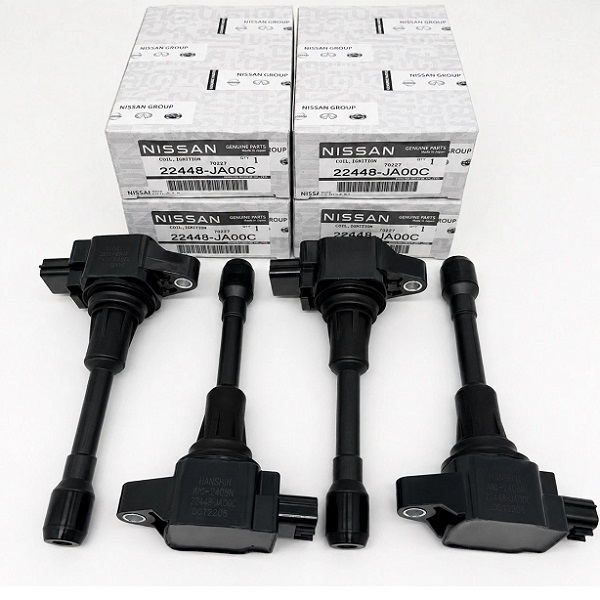
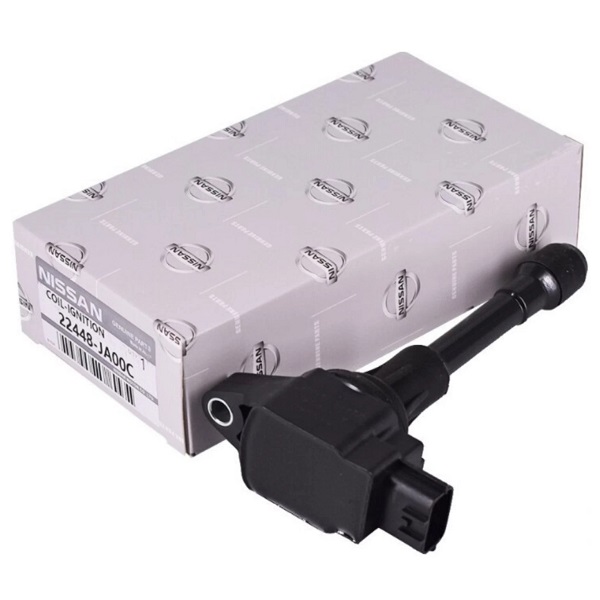
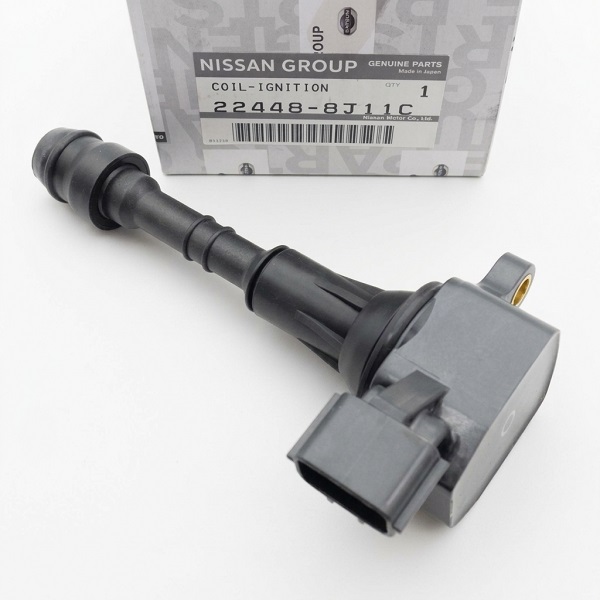
Description
Genuine Nissan Ignition Coils
A genuine Nissan ignition coil ensures optimal engine combustion, instant throttle response, and maximum fuel efficiency by stepping up vehicle battery voltage into high-voltage electrical surges that spark the cylinders, preventing misfires, power loss, and unburned fuel contamination in Kenya.
What Are Genuine Nissan Ignition Coils?
 Ignition coils—commonly designed as Coil-on-Plug (COP) units in modern engines—are high-voltage compact transformers mounted directly above each cylinder’s spark plug. Constructed with primary and secondary copper wire windings wrapped around a laminated magnetic steel core and sealed inside a heat-resistant resin body, they receive low-voltage signals (12V) from the Engine Control Module (ECM). The coil instantly transforms this current into high-voltage electrical pulses (up to 30,000+ volts) and delivers them directly to the spark plug electrode.
Also See: Genuine Nissan Rear Brake Linings
What Do Genuine Nissan Ignition Coils Do?
The primary function of an ignition coil is converting low battery voltage into high-voltage pulses required to jump the spark plug gap.
Key functions of genuine Nissan ignition coils include:
- High-Voltage Voltage Transformation: Elevates 12-volt vehicle battery power to tens of thousands of volts required for electrical arc discharge under high combustion pressures.
- Direct Plug Mounting (COP Efficiency): Mounts directly onto the spark plug insulator, eliminating high-tension spark plug wires, reducing electrical resistance, and minimizing timing delay.
- Combustion & Emissions Control: Fires with microsecond timing accuracy to ensure complete fuel combustion, maintaining low exhaust emissions and protecting catalytic converters from unburned raw fuel.
- Thermal & Electrical Insulation: Sealed with high-grade epoxy resin to withstand extreme engine bay heat, engine vibration, and high-voltage dielectric breakdown.
Common Nissan Vehicles in Kenya That We Service Ignition Coils
Ignition coil body lengths, rubber boot shapes, connector pin counts (3-pin vs. 4-pin with integrated transistors), and mounting bolt flanges vary by engine series. Below is a compatibility overview:
| Nissan Model | Generation / Model Years | Engine Variants | Ignition Coil Fitment & Notes |
| Nissan Note / March | E11 / E12 / K12 / K13 | HR12DE, HR15DE, CR12DE | Compact 3-pin COP ignition coil set. |
| Nissan Tiida / Latio / Wingroad | C11 / Y12 | HR15DE, MR18DE | Standard 3-pin coil pack; check boot seals for oil contamination. |
| Nissan X-Trail | T30 / T31 / T32 | QR20DE, QR25DE, MR20DD | High-output ignition coils; MR20DD uses high-energy direct-injection coils. |
| Nissan Qashqai / Dualis | J10 / J11 | HR16DE, MR20DE, MR20DD | High-heat-resistant coil-on-plug modules. |
| Nissan Serena | C24 / C25 / C26 / C27 | QR20DE, MR20DE, MR20DD | Heavy-duty ignition coils engineered for multi-passenger engine loads. |
| Nissan NV200 / AD Van | M20 / Y12 | HR16DE, CR12DE, HR15DE | Durable commercial-grade coil-on-plug units. |
| Nissan Teana / Murano / Fuga | J31 / J32 / Z50 / Z51 / Y50 | VQ23DE, VQ25DE, VQ35DE | Set of 6 high-output V6 ignition coils. |
| Nissan Patrol | Y61 / Y62 | TB48DE, VK56VD | Heavy-duty multi-cylinder high-performance ignition coils. |
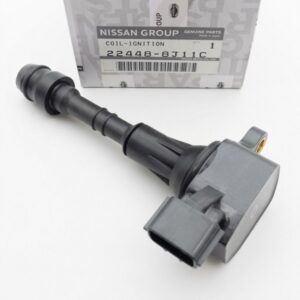 Note: Ignition coils differ between 3-pin standard and 4-pin direct-injection variants. Always verify your vehicle’s VIN or chassis number prior to purchasing.
Contact Doctor Carz Auto today via WhatsApp or call +254 715 803 098 to confirm fitment for your vehicle chassis code or to arrange local delivery/installation in Nairobi.
Signs Your Nissan Ignition Coils Need Replacement
A failing or shorted ignition coil prevents complete cylinder combustion. Watch for the following warning indicators:
- Engine Misfire & Violent Shaking at Idle: Severe engine vibration felt through the cabin or steering wheel due to a dead cylinder.
- Check Engine Light (Flashing / Solid): Dashboard light illuminated with OBD-II codes P0300 (Random Misfire), or P0301, P0302, P0303, P0304 (Specific Cylinder Misfire).
- Sudden Hesitation & Loss of Power: Vehicle stutters or jerks violently when stepping on the gas pedal to accelerate or climb hills.
- Increased Fuel Consumption & Raw Exhaust Smell: Unburned gasoline escaping through the exhaust pipe due to lack of spark.
- Hard Starting & Engine Stalling: Engine cranks excessively or stalls randomly at stoplights.
When Should Nissan Ignition Coils Be Replaced?
Ignition coils undergo severe thermal cycle stress inside the cylinder head wells.
- Standard Replacement Lifespan: Replace ignition coils every 100,000 km to 120,000 km.
- Replace Upon Failure / Diagnostic Code: Replace immediately if internal copper windings break or high-voltage arc leaks occur.
- Secondary Failure Causes: Replace rubber boots immediately if degraded by valve cover gasket oil leaks.
How to Choose the Right Ignition Coils for Your Nissan
Consider the following technical specifications when purchasing replacement coils:
- Matching OEM Wiring Pins: Verify 3-pin vs. 4-pin electrical connectors and internal power transistor logic.
- Dielectric Boot Insulation: Ensure high-grade silicone boots that resist high-voltage flashover and oil degradation.
- Genuine OEM vs. Premium OES (Hanshin / Hitachi): Genuine Nissan coils (often manufactured by Hanshin or Hitachi) match factory dwell timing and secondary output energy.
How to Get the Best Performance and Longest Coil Life
- Replace Spark Plugs Timely: Worn spark plugs with wide electrode gaps force ignition coils to operate at dangerously elevated voltages, leading to internal coil insulation breakdown.
- Fix Valve Cover Gasket Leaks: Engine oil leaking into the spark plug wells degrades the rubber coil boot and causes spark shorting.
- Apply Dielectric Grease: Apply a thin film of dielectric grease inside the tip of the rubber coil boot to prevent moisture intrusion and boot sticking.
Replacing and Installing Your Nissan Ignition Coils
Replacing coil-on-plug units is a precise procedure:
- Turn off the ignition, open the hood, and remove the plastic top engine decorative cover.
- Press the locking tab and disconnect the electrical harness plug from the ignition coil.
- Unbolt the coil securing bolt (typically 10mm bolt head).
- Gently twist and pull the ignition coil unit straight up out of the spark plug well.
- Inspect the spark plug well for oil accumulation (replace valve cover tube seals if oil is present).
- Apply dielectric grease to the tip of the new genuine coil boot and push the new coil onto the spark plug.
- Re-bolt the retaining bolt, reconnect the electrical connector, refit engine cover, and clear OBD-II misfire codes.
For technical ignition diagnostics and misfire repairs, visit our specialized service garage in Kasarani, Nairobi.
Why Choose Nissan Ignition Coils from Doctor Carz Auto?
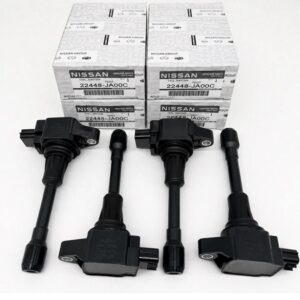 At Doctor Carz Auto in Kasarani, Nairobi, we stock genuine OEM and original Hanshin/Hitachi ignition coils designed for complete Nissan engine performance. Our technical team cross-references your chassis or VIN number to guarantee exact pin layout, dwell timing, and high-voltage output for smooth, misfire-free driving.
Need the Right Nissan Ignition Coils?
Contact Doctor Carz Auto today to verify fitment, check current pricing, or schedule professional ignition diagnostics.
- Call/WhatsApp: +254 715 803 098
- Email: nissan@doctorcarzauto.co.ke
- Location: Kasarani, Seasons Behind Jalyn Junior School, Nairobi, Kenya
- Website: https://doctorcarzauto.co.ke/
FAQs About Nissan Ignition Coils
- Q1: What do genuine Nissan ignition coils do?
A: They transform 12-volt battery power into 30,000+ volt surges to create the spark at the spark plug, igniting fuel inside the engine cylinders. - Q2: Can I replace just one faulty ignition coil, or should I replace all of them?
A: While you can replace a single failed coil to fix an immediate misfire, if the coils are old (over 100,000 km), replacing the entire set ensures equal output energy and prevents subsequent coil failures. - Q3: What causes an ignition coil to fail prematurely?
A: Common causes include worn spark plugs with wide gaps, extreme engine heat, engine oil leaking into spark plug wells, and electrical surges. - Q4: Can a faulty ignition coil damage my catalytic converter?
A: Yes. A dead ignition coil allows unburned raw fuel to pass into the exhaust system, where it ignites inside the catalytic converter, causing extreme overheating and honeycomb destruction. - Q5: What are the main OBD-II fault codes for ignition coil failure?
A: Typical codes include P0300 (Random/Multiple Cylinder Misfire) or specific cylinder codes P0301 (Cylinder 1), P0302 (Cylinder 2), P0303 (Cylinder 3), and P0304 (Cylinder 4). - Q6: How do I verify which ignition coil fits my Nissan model?
A: Share your vehicle chassis or VIN number with our Doctor Carz Auto technical team via WhatsApp (+254 715 803 098) for exact fitment verification.
Reviews
There are no reviews yet.